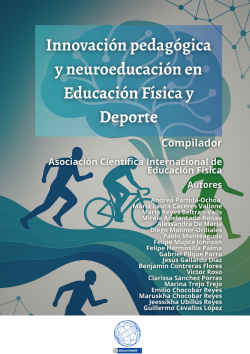
PEDAGOGICAL INNOVATION AND NEUROEDUCATION IN PHYSICAL EDUCATION AND SPORT
Keywords:
innovation, physical education, schoolSynopsis
Innovation in Pedagogy and Neuroeducation in Physical Education and Sport brings together six chapters that examine—ranging from sport psychology to occupational health—how to rethink teaching and motor practice through evidence-informed approaches. Chapter 1 argues that success is not driven by rewards alone, but by motivational quality. Drawing on Self-Determination Theory, it emphasizes autonomy, competence, and relatedness as needs that sustain intrinsic motivation, persistence, and well-being, while warning that ego-oriented climates increase pressure and dropout. Chapter 2 (the CAFYDIA project) explores perceptions of AI for teaching in a Problem-Based Learning session using a chatbot (Gemini) with 38 university students: most view it as useful for rapid learning and recommend integrating it, but they also call for stronger digital literacy and strategies that protect critical thinking. Chapter 3 discusses chaos theory applied to Physical Education, highlighting epistemological contributions (complexity and informal learning), biological links with heart rate variability, and its potential to enrich curriculum design. Chapter 4 reviews how physical activity supports neuroplasticity and executive functions, proposing game-based, coordination, and motor-learning routines as neuronal stimulation. Chapter 5 addresses inclusion for students with ASD through TEACCH, stressing visual structure and predictable routines to reduce anxiety and enhance coordination and social skills. Finally, Chapter 6 synthesizes PRISMA 2020 evidence (20 studies, 2023–2025) on workplace active breaks: interrupting sedentary time every 30–60 minutes with 2–10 minutes of activity—supported by reminders and institutional leadership—improves cognitive and musculoskeletal indicators.
References
Partida, A., Cáceres, M., Beltrán, M., Adelantado, M., De Maria, M., Moliner, D., Monteagudo, P., Mujica, F., Hermosilla, F., Pilque, G., Gallardo, J., Contreras, B., Roso, V., Sánchez, C., Trejo, M., Chocobar, E., Chocobar, M., Ubillús, J., & Cevallos,G.(2026). Innovación pedagógica y neuroeducación en educación física y deporte. Editorial ACIEF.
Downloads
Published
Series
Categories
License

This work is licensed under a Creative Commons Attribution-NonCommercial-NoDerivatives 4.0 International License.
Publications of ACIEF Publishing are distributed under the Creative Commons Attribution–NonCommercial–NoDerivatives 4.0 International License (CC BY-NC-ND 4.0).